The weight of the world seemed to lift from my shoulders as I opened that first envelope. Inside was a letter from Jenny, penned in the careful, deliberate script I had come to know so well over the years. It was a letter that spoke directly to the heart—full of her characteristic foresightedness, warmth, and wit.
“My Dearest Samuel,” it began, “You must be wondering why I have left you this farm. You always did love history, and here is where you will find a piece of mine—of ours. This place isn’t just land; it’s a legacy. It holds stories you need to tell, and lessons you need to teach. Our son may find value in the city, but true worth often lies concealed beneath layers of dust and time. Trust it, Samuel. Trust me.”
As I read the letter, a flood of emotions washed over me. It suddenly became clear why Jenny had chosen this farm for me while gifting our son the penthouse. She had left me a gift, not a burden—a chance to reconnect with the past, to embrace simplicity, and to rediscover the part of myself that had long been overshadowed by the clamor of city life.
I turned my attention to the second envelope. Inside was a series of maps and documents detailing the farm’s history. Generations of stories, harvests, and whispers from the past echoed through those pages. Jenny had meticulously documented everything about the farm—its best planting seasons, its most fertile soils, even its quirkiest old machinery. But there was one document that stood out—a deed with a recent survey attached. The land stretched further than I had imagined, reaching out to the horizon with untapped potential.
But why the barn? Jenny’s note in the cardigan had directed me there after entering the house. It was as if she had laid out a treasure hunt, each clue leading me deeper into understanding her final gift.
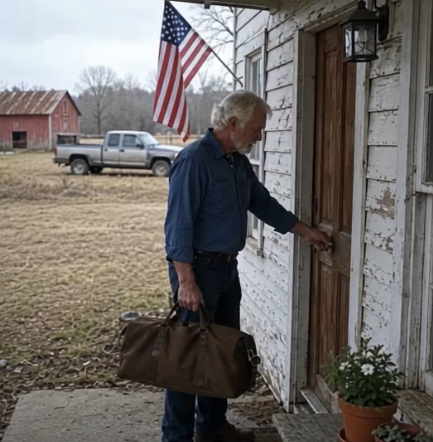
Taking a deep breath, I stepped outside. The air was crisp, carrying the scent of earth and promise. The barn loomed, an imposing structure of weathered wood and rusted nails, standing sentinel over the past and future. Its doors were heavy but yielded easily as I pushed them open.
Inside, sunlight filtered through cracks in the wood, casting beams onto a large, covered object in the center. With a sense of anticipation, I pulled back the dusty tarp to reveal a classic tractor, gleaming as if it had just rolled off a showroom floor. Alongside it sat a collection of tools, manuals, and a neatly organized workspace.
Jenny had seen to it that I would not just inherit land, but the means to work it. She had known that while the penthouse symbolized a new chapter for our son, the farm was my new beginning—a chance to cultivate, to grow, to heal.
In that moment, I realized that Jenny had given me more than just a piece of property. She had given me a sanctuary—a place where I could find peace, purpose, and perhaps even a new sense of identity. I could already see myself teaching history lessons out here, finding parallels between the cultivation of land and the cultivation of young minds.
Jenny had left me with more than answers; she had given me a future. Trust the farm, she had said. And as I stood in the barn, I finally understood that the farm was not just a place—it was a promise of renewal, a testament to Jenny’s unending wisdom, and a chance to start anew.
 Top Video Viral