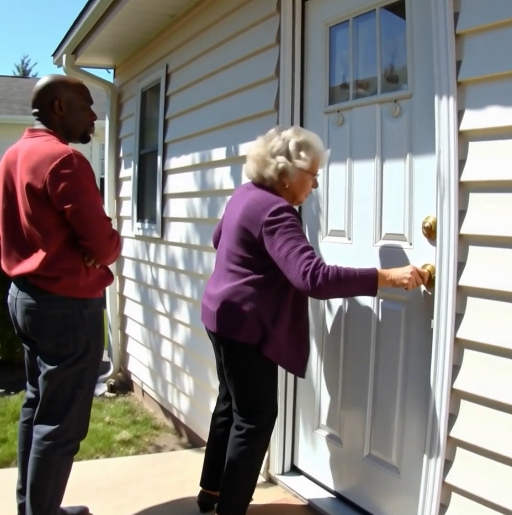
I hesitated, my heart pounding in my chest. This wasn’t the humble home I remembered; it was as if the past had been scrubbed away and replaced with something entirely foreign. I stood there, frozen, until a voice pulled me from my stupor.
“Can I help you?”
The voice belonged to a young woman watering plants in the garden. Her eyes were curious but friendly. I cleared my throat, trying to steady my voice.
“I’m looking for Doña Clara,” I said. “She used to live here.”
The woman paused, setting down her watering can. “Ah, Doña Clara. Yes, she used to live here,” she said, a hint of nostalgia in her voice. “But she moved away a while ago.”
Moved away? The words echoed in my mind, reverberating with disbelief. “Do you know where she went?” I asked, trying to mask the urgency in my voice.
“Let me think,” she said, tapping a finger to her chin. “She mentioned going to live with family in the city. Sorry, I don’t remember which one.”
I thanked her and walked back to my car, my mind racing. How could she have moved without telling me? Why hadn’t she updated her contact details?
Driving back to the village’s small plaza, I hoped to find someone who could give me answers. I stopped at the local café, the type of place where everyone knew everyone else’s business.
Inside, the air was warm and fragrant with the scent of freshly brewed coffee. I approached the barista, a middle-aged man with kind eyes.
“I’m looking for Doña Clara,” I began. “I heard she moved. Do you know where?”
He frowned, concern etching lines across his forehead. “Ah, Doña Clara. We used to see her often, but she just disappeared one day. We were worried.”
Disappeared. The word sent a chill through me. I asked if anyone else might know more, and he nodded towards a table where a group of elderly women sat, chatting over tea.
Approaching them, I repeated my request. One of the women, her face framed by soft white curls, spoke up. “Clara was a dear friend,” she said wistfully. “But she left so suddenly. We heard her health was declining.”
Declining? The news hit me like a punch to the gut. Had she been sick without my knowing? I struggled to maintain my composure.
As I thanked them and turned to leave, the white-haired woman reached out, placing a frail hand on mine. “If you find her,” she said softly, “tell her we miss her.”
Back in my car, I sat in silence, the weight of uncertainty pressing down on me. I dialed Jorge’s number, needing the grounding presence of my best friend.
“Hey, it’s me,” I said when he picked up. “I’m in Marina’s hometown. Something’s wrong.”
“Roberto, what happened?” he asked, concern lacing his voice.
I explained everything—the new house, the unknown whereabouts, the whispers of poor health. “I don’t know what to do,” I admitted.
“Listen,” Jorge said, his tone steady. “You’ve done your part. But maybe it’s time to let Marina rest. You’ve held onto this connection for so long—maybe it’s time to let go.”
His words, though gently spoken, felt like a release. Perhaps he was right. Perhaps it was time to find peace for myself.
I drove home the next morning, the sun rising behind me, casting long shadows on the road ahead. It was time to live—not in the past, but in the present. And as I drove, I felt the first hints of warmth and hope begin to seep into my heart, promising new beginnings.
 Top Video Viral