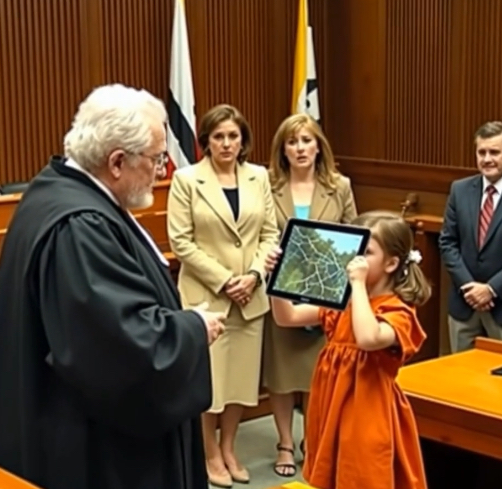
Zariah’s small fingers danced over the cracked screen, her determination palpable as she navigated through the cluttered icons and opened a video file. The courtroom was silent, every eye trained on her as curiosity mingled with tension in the air. I could feel my heart pounding in my chest, a mixture of fear and hope swirling inside me. What could my little girl possibly have that could change the course of this hearing?
As the video began to play, the grainy image stabilized to reveal our living room. There was Zariah, her voice sweet and innocent, narrating the scene like a child documenting an adventure. Her tiny face filled the screen, and behind her, the truth slowly unfolded.
It started with my husband, Tmaine, his voice no longer the smooth, controlled tone he’d used in court but harsh and impatient. He was arguing over the phone, snippets of his conversation slipping through the static. “Of course, she doesn’t know,” and “She’ll never find out,” were clear enough to send a chill down my spine. Zariah, unseen by him, had captured his words, providing a glimpse behind the mask he’d worn so well.
Next, the camera shifted. There was Tmaine again, laughing into another call, and then the screen showed him meeting with Valencia, the family psychologist. Their interaction was too close, too familiar, and as Zariah continued to film with child-like curiosity, it became apparent that they were more than just acquaintances. Her secret recordings painted a picture of a conspiracy, a betrayal that extended beyond just emotional distance.
The courtroom remained silent, the judge leaning forward slightly, his attention riveted on the unfolding drama. I watched, my breath caught in my throat, as the video played on. There was another clip of Tmaine, this time counting money, the same money I had thought lost or spent. His voice was clearer now, bragging on the phone about his plans, about how he was going to “start fresh” without me.
My daughter had unknowingly documented a narrative of manipulation and deceit, her innocent eyes capturing moments that spoke volumes. As the video ended, Zariah looked up at the judge, a mixture of fear and determination on her face.
“I just wanted you to know,” she said softly, “my mommy loves me. She’s not bad. She didn’t know what Daddy was doing.”
The judge sat back, his gaze shifting from the tablet to my husband, then to me. There was a long pause, the weight of Zariah’s evidence hanging heavy in the air. My husband’s attorney fumbled with his papers, and I could see the cracks in their perfect facade starting to show.
Abernathy leaned over to me, whispering, “This changes things. It really does.”
The judge cleared his throat, his expression thoughtful. “Thank you, Zariah,” he said gently. “You’ve been very brave.”
I reached out for her as she returned to my side, clutching that cracked tablet like a shield. My heart swelled with pride and gratitude, knowing that my daughter’s courage had given us a fighting chance.
The judge addressed the court, his tone measured. “Given this new evidence, I will need time to review and reconsider the circumstances of this case. We’ll reconvene with a fresh perspective.”
As the gavel came down, signaling a temporary reprieve, I pulled Zariah close. The battle was far from over, but for the first time, I felt a glimmer of hope. Together, we had a chance to reclaim our story, to hold onto each other, and to find our way through the darkness.
 Top Video Viral